ECT measures the edgewise compression resistance of corrugated board; BCT measures the compression resistance of a finished box. They answer different purchasing questions. An ECT value helps define the board, while a box compression result helps evaluate a particular container design under stated test conditions. Neither number alone establishes that a packed product will survive its distribution route.
For export buyers comparing custom corrugated shipping boxes, the useful specification combines material, box geometry, closure, load arrangement, environmental exposure and a measurable acceptance plan. This guide explains how to connect those details without treating a catalogue strength rating as a shipping guarantee.
ECT versus BCT: what each result actually tells you
Edge crush test: a board-level measurement
The edge crush test loads a short specimen of corrugated board along its edge, parallel to the flutes. The result expresses force per unit length, commonly reported in kN/m or lbf/in. TAPPI/ANSI T 811 describes one edgewise compression method. Other methods and specimen preparation procedures exist, so an ECT number should always identify the method and units.
ECT is useful when comparing board constructions or checking incoming material against an agreed specification. It does not describe the complete box: panel dimensions, slots, scores, joints, printing damage and closure are outside the information supplied by the board result alone.
Box compression test: a container-level measurement
BCT applies compression to the assembled container and reports force, commonly in N, kN or lbf. ASTM D642 covers compression testing of containers, components and unit loads. Ask whether the tested specimen was empty or packed, which orientation was used, how it was closed and what conditioning preceded the test. These details affect whether the result is relevant to your shipment.
A useful comparison is therefore the same box design, assembled and conditioned in the same way. Two cartons made from board with the same ECT can produce different BCT results. Equally, two BCT reports cannot be compared confidently if one uses a packed box with load-bearing contents and the other an empty box.
Why a laboratory compression value is not a safe stacking weight
A short-duration compression test characterizes the tested configuration. Warehouse stacking can place the bottom carton under sustained load for days or weeks. Humidity, handling damage, pallet support and stack alignment also change the situation. Treating the maximum laboratory force as an allowable long-term stack load removes those conditions from the decision.
First estimate the nominal load above the bottom carton in a simple aligned vertical column:
Nominal vertical force = (number of cartons in the column − 1) × gross mass per carton × gravitational acceleration.
For illustration, a six-carton column with a gross mass of 12 kg per carton places approximately 60 kg of cartons above the bottom one: 5 × 12 × 9.81 ≈ 589 N, or 0.59 kN. This is an arithmetic example, not a recommended box strength. It assumes a simple column and excludes load redistribution, pallet deflection, transport forces and any load shared by the contents.
The required margin must be established for the actual route, storage duration and failure consequences. Avoid applying a universal safety factor copied from an unrelated product. Have the packaging supplier or testing laboratory connect the required performance to a documented test plan.
Five specification details that change the result
1. Internal dimensions and box style
State length, width and depth in a defined order and specify whether they are internal dimensions. Include the box style or drawing, joint construction, hand holes and ventilation openings. Small dimensional changes can alter panel behavior; changing the style can also change the load path. The product should fit with its intended cushioning rather than move freely inside an oversized carton.
2. Board construction and flute combination
Record single-wall or double-wall construction, flute combination, liner and medium specification where agreed, and the ECT requirement. Wall count and paper grammage are not substitutes for measured package performance. A thicker board may suit cushioning or puncture-related concerns without automatically providing the required stacking performance.
3. Pallet pattern and support
Provide the actual pallet footprint, deck arrangement, carton layout, layer count and overhang limits. Misaligned carton walls, gaps in support and load overhang can change how compression travels through the stack. Evaluate the intended palletized configuration rather than only a perfectly aligned single carton.
4. Humidity and storage time
Specify the anticipated storage and transport environment. ASTM D4332 addresses conditioning atmospheres for containers and packaging components and distinguishes transit-simulation conditioning from standard-atmosphere quantification of box compression. Ask the laboratory to identify the appropriate conditioning practice and record temperature, relative humidity and duration in the report. A result without its conditioning history leaves a major comparison gap.
5. Closure and internal protection
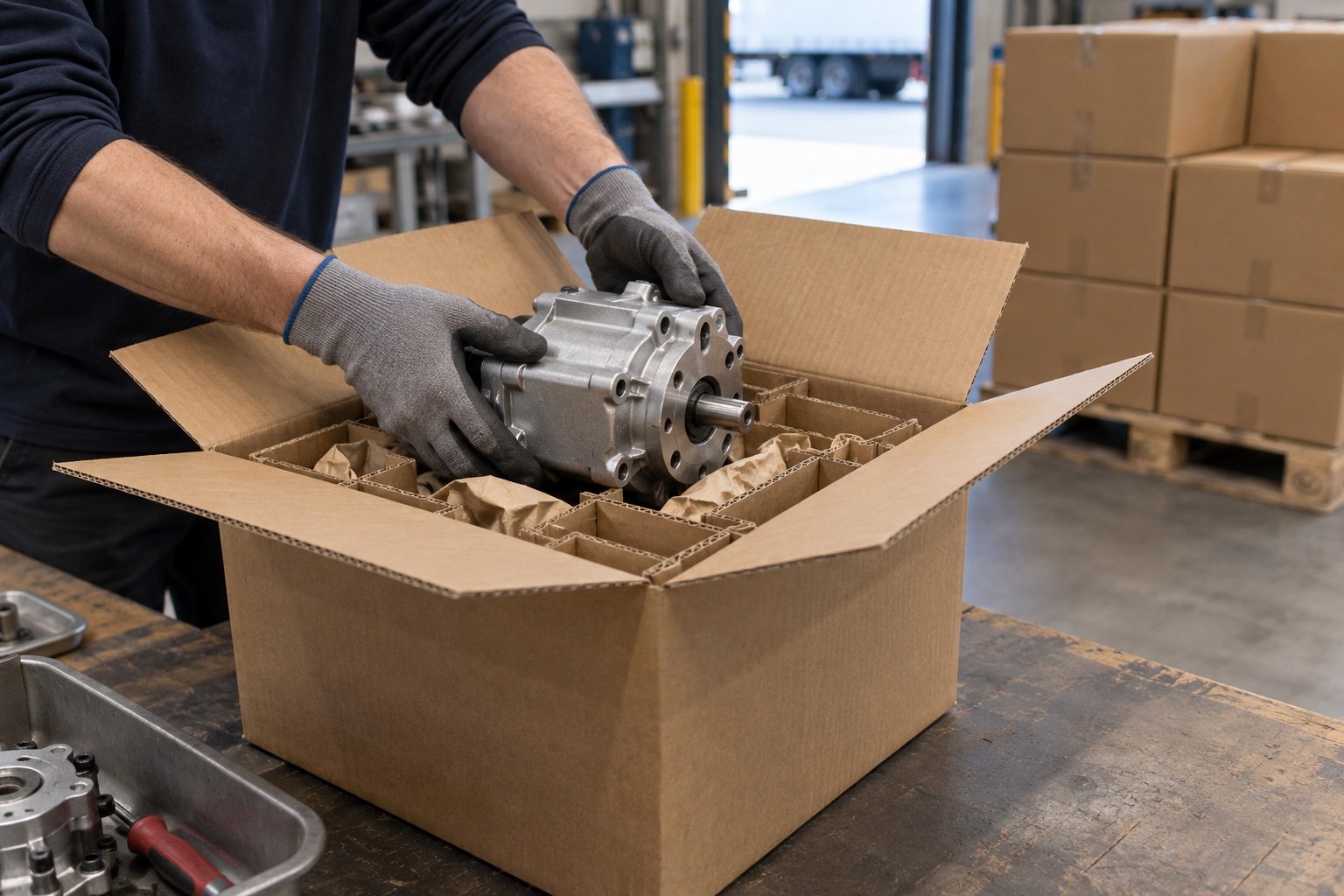
Define the tape or adhesive closure and the inserts, partitions or pads present during testing. Contents that share compression load must be identified. For fragile items, combine carton selection with suitable corrugated protective materials; compression performance does not establish resistance to every impact or abrasion hazard.
Build an acceptance plan before production
- Freeze the design: approve the drawing, material construction, closure and internal pack.
- Define the sample: identify whether testing covers board, empty cartons, packed cartons or the full pallet load.
- Agree on conditions: record conditioning, test orientation, method, sample quantity and acceptance criteria.
- Evaluate distribution hazards: add suitable handling, vibration, drop or other tests where the route requires them.
- Control repeat orders: retain the approved specification and establish which material or design changes require re-evaluation.
A report should identify the tested design and provide individual results as well as the agreed summary. A generic certificate for a different carton size is not evidence that your package meets the same requirement. A compression test is also not an ISTA certification or proof that every transport hazard has been assessed.
What to include in a corrugated box RFQ
- Product dimensions, gross packed mass, fragility and photographs.
- Box drawing, internal dimensions, style and required printing.
- Board construction, ECT or other material requirements, with units and methods.
- Pallet layout, stack height, storage duration and expected climate.
- Closure, cushioning and any load-bearing internal components.
- Required tests, acceptance criteria, order quantity, destination and delivery date.
Frequently asked questions
Can ECT be converted directly into BCT?
Not as a universal conversion. Predictive equations can support early design work, but their assumptions and input data must match the carton. Use testing to validate the selected construction and package configuration when compression performance is an acceptance requirement.
Does a higher ECT always mean a better shipping box?
It indicates a higher board edgewise compression result under the specified method. It does not independently establish fit, puncture resistance, cushioning, moisture performance or finished-box strength.
Should I request empty-box or packed-box testing?
Specify the purpose. Empty-box testing helps compare container designs; packed-box testing can evaluate the assembled system, including any load sharing. The laboratory should help choose a configuration that answers the purchasing question.
Send HengNice your carton drawing, load details and test requirements to discuss a corrugated packaging specification and quotation.